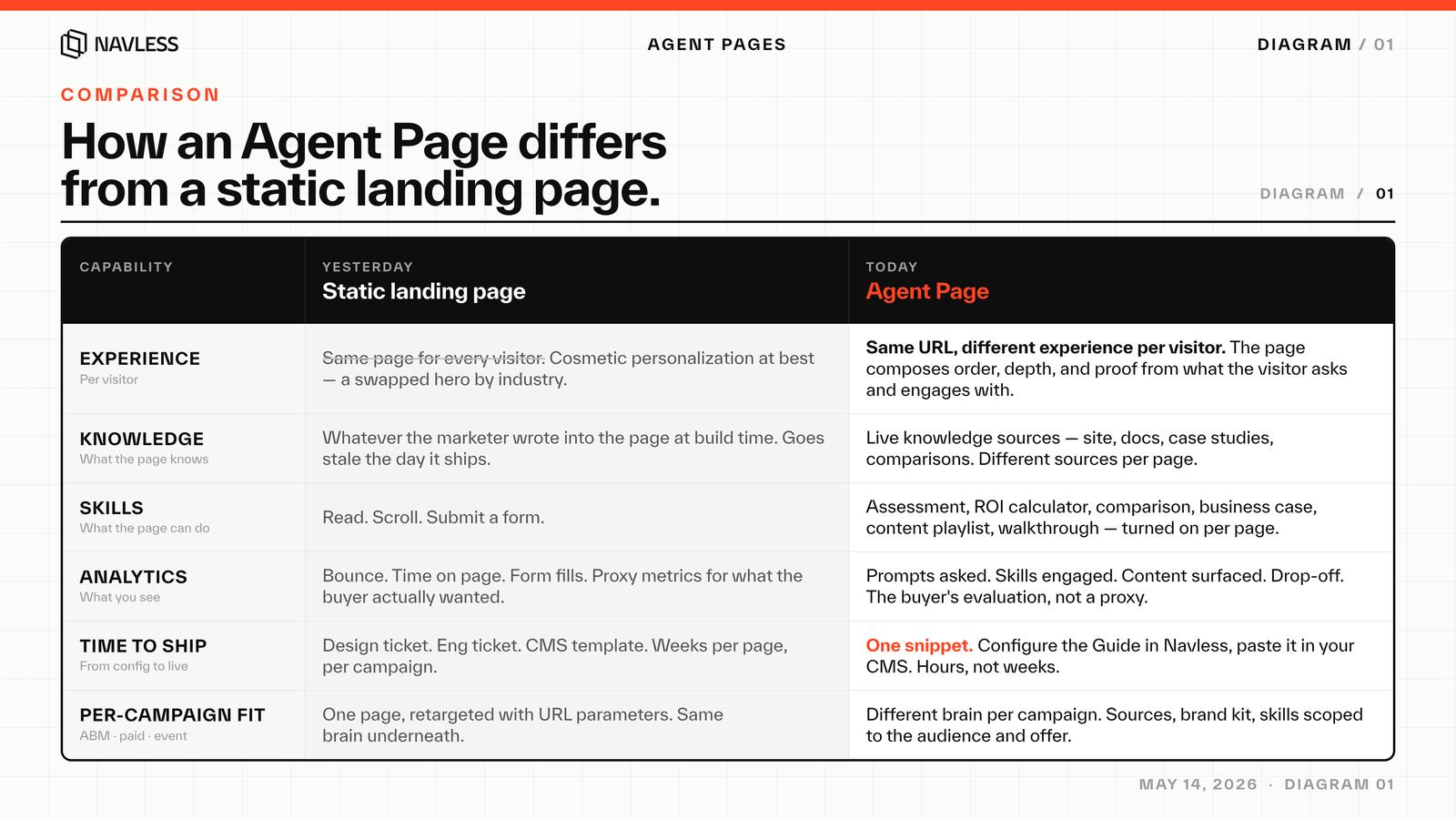
Static Landing Page vs. Agent Page Comparison
The comparison highlights that Agent Pages, unlike static landing pages, deliver personalized visitor experiences using live knowledge sources and interactive tools, offer detailed analytics on buyer engagement, adapt dynamically to different campaigns, and can be deployed rapidly via a single snippet, whereas static landing pages provide uniform, stale content with limited interactivity, basic analytics, and require longer development times.
Related
What actually happens when a buyer lands on an Agent Page
When a visitor lands on an Agent Page, an intelligent Guide immediately analyzes their arrival source, behavior, and intent—such as their referral channel, page interactions, and questions asked—to dynamically tailor responses and content from connected knowledge sources, providing a personalized, interactive experience that helps the visitor efficiently find relevant information and make informed decisions.
Choosing between Drift, Intercom, or Qualified for startups?
For B2B SaaS startups deciding between Drift, Intercom, or Qualified, Drift and Qualified excel at quickly converting high-intent website visitors into sales-qualified meetings through direct sales handoff and CRM integration, while Intercom is better suited for customer support, onboarding, and post-sale engagement, highlighting that most visitors actually need educational self-service rather than immediate demo booking.
The State of B2B Chatbots
A December 2025 Navless study of 100 mid-market US B2B SaaS websites found that most chatbots fail to educate buyers by inadequately answering key top-of-funnel questions—66% couldn't explain the company, 70% failed to differentiate it, 83% couldn't provide case studies, and only 9 of 34 AI-labeled bots passed all criteria—highlighting that chatbots primarily qualify leads rather than support the AI-driven buyer's self-education process.
What is an AI buyer journey and why does it matter for B2B?
The AI buyer journey in B2B, driven by generative AI tools like ChatGPT, has transformed the traditional linear sales funnel into a fast, fragmented, and non-linear process where buyers rely heavily on AI for research, evaluation, and decision-making—making it crucial for B2B teams to optimize their brand visibility and messaging for AI-driven discovery to avoid invisibility in the buying process.
The Cost of a Fragmented AI Funnel: What Marketing Leaders Actually Lose When Point Solutions Don't Connect
The article explains that B2B marketing leaders face significant losses in pipeline, conversion, and revenue metrics when relying on disconnected point solutions for the three critical stages of the AI funnel—pre-click discovery, post-click evaluation, and customer expansion—because these fragmented tools create friction and context loss that ultimately cause potential buyers to drop out, undermining the short tenure and high accountability pressures CMOs and CROs face in rapidly driving measurable business outcomes.
How should I implement AI in my B2B digital marketing strategy?
The article advises B2B SaaS marketers to move beyond fragmented AI tools by implementing a unified AI platform that controls the entire buyer journey—from increasing visibility in AI-driven vendor shortlists, delivering personalized real-time website experiences to drive conversions, to proactively growing existing accounts—starting with clear, measurable objectives and a thorough audit of data and tools for seamless integration.